

PIPL China — product gates that stop go-live
PIPL China is a product go-live gate map — inventory, purpose, consent, processors, security, then the cross-border fork. Miss a gate and the launch is incomplete.
PIPL China is a product go-live gate map — not a privacy-policy rewrite. Before you ship a China-facing app, site, or Mini Program that collects personal information of individuals in Mainland China, your team must clear inventory, purpose and necessity, legal basis (often consent), processor contracts, and security — then decide the cross-border data transfer (CBDT) fork. The Personal Information Protection Law (个人信息保护法) is the statute; product teams fail when they ship on a global privacy PDF instead of clearing those gates. The SaaS-shaped program these gates sit inside: SaaS in China.
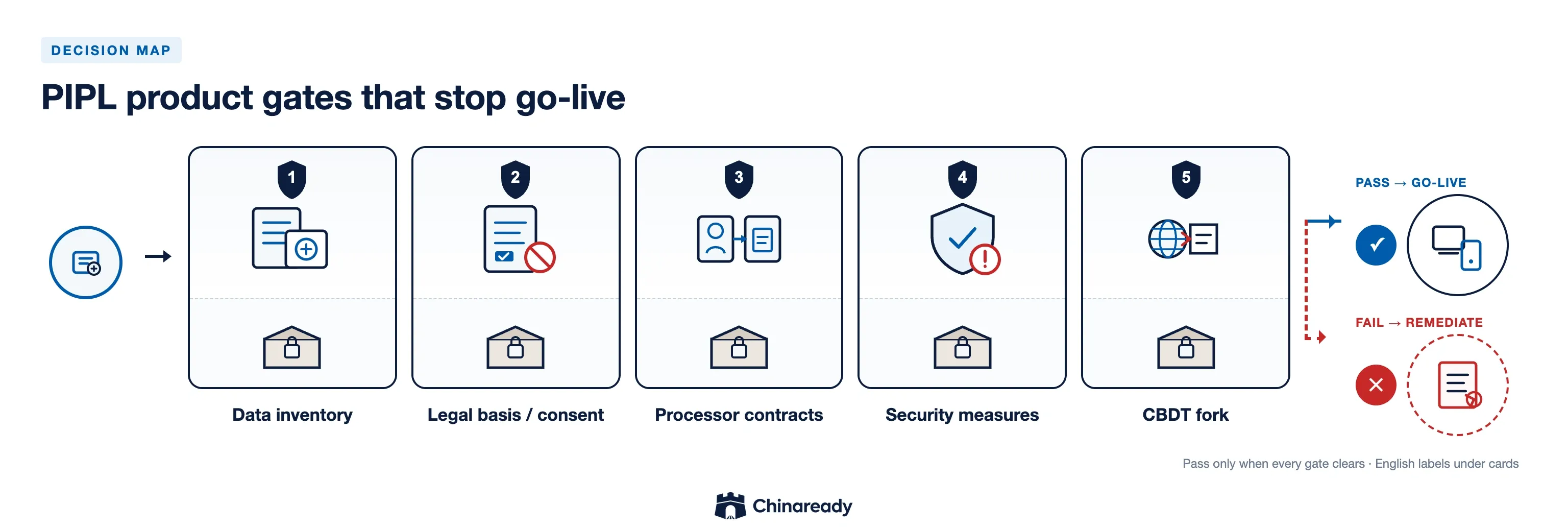
What PIPL China means for product go-live
Hard names your launch program will use:
- Personal Information Protection Law (个人信息保护法) — Baseline statute for processing personal information of natural persons in Mainland China (CAC text).
- Personal information / sensitive personal information — Identity, contact, device, location, account, and similar identifiers; sensitive categories (e.g. biometrics, medical, financial, minors’ data) need a stricter basis and usually separate consent.
- Personal information processor — The organisation that determines purpose and means (your product entity or China landing path) — not “the vendor that stores the logs.”
- Entrusted processing — SDKs, clouds, CRMs, and analytics acting on your instructions need processor contracts and supervision, not a checkbox in a global MSA.
- Lawful basis — Consent is common for consumer products; other statutory bases exist. Product UX that buries consent in a global English policy usually fails China store and CAC-adjacent questionnaires.
- Security measures — Encryption, access control, logging, retention limits, and incident handling proportionate to the processing — overlapping MLPS for China-operated systems, but MLPS does not replace PIPL gates.
- Outbound / CBDT fork — If China-sourced personal information leaves Mainland China, PIPL plus CAC outbound rules apply. Sequence that fork on Cross-border data transfer; do not invent a “license” to export data.
- Common myth — “We already did GDPR / CCPA.” Those programs do not auto-clear China PIPL compliance, Chinese notices, or CAC transfer paths.
Vocabulary first. Next: what must exist before these gates are executable.
What must exist before PIPL gates can run
Missing any of these stops your product team before an honest go-live — not after the privacy PDF is uploaded to a store console.
| Precondition | Why your process stalls |
|---|---|
| China-facing surface inventory — app, web, Mini Program, login, payments, support | You cannot gate “the brand”; you gate named collection points |
| Data inventory — fields, sources, purposes, retention, destinations | Store questionnaires and CAC packs reject vague global RoPA copies |
| Purpose and necessity map — why each field exists for this product | Over-collection (especially identity and location) fails PIPL and UX together |
| Legal-basis design — consent UX, sensitive-PI separate consent, withdrawal | English-only banners and bundled “accept all” fail review and enforcement |
| Processor / SDK list with China processing reality | Hidden overseas analytics and crash SDKs create an undeclared CBDT |
| Security owner and evidence | Encryption claims without access control and incident owners fail diligence |
| Mainland China entity or landing-partner path | Chinese notices, contracting, and CAC channels usually need a China organizing path |
Login, payments, captcha, and real-name flows are collection gates when they take personal information — align them here, then execute on login and payments, CAPTCHA and forms, and real-name verification rather than treating those Guides as a PIPL substitute.
PIPL product gates from inventory to CBDT
Use this as a go-live gate map. Stages are decisions, not console click-paths.
| Stage | Decision / outcome |
|---|---|
| 1. Freeze the data inventory | Every China-facing field, SDK, and log sink named; no “we’ll document after launch” |
| 2. Lock purpose and minimisation | Drop fields that are not necessary for the stated purpose; split marketing vs service processing |
| 3. Run the legal-basis / consent gate | Lawful basis per purpose; separate consent for sensitive personal information; withdrawal that actually works |
| 4. Contract processors | Entrusted-processing terms, subprocessors, and deletion/return on exit — including China cloud and global SaaS |
| 5. Prove security measures | Access, encryption, retention, and incident path that match the inventory — not a generic ISO slide |
| 6. Fork on CBDT | If personal information stays in Mainland China, document that. If it leaves, stop and run Cross-border data transfer (assessment / standard contract / certification under CAC rules) |
| 7. Only then call go-live | Store privacy questionnaires, ICP/hosting stories, and CAC-adjacent asks must describe the same diagram |
CAC is the regulator umbrella for personal-information and outbound-data tracks — see Cyberspace Administration of China for which surfaces trigger CAC-led work. Hosting locality belongs beside this map: China Product Hosting.
Why one PIPL fail blocks go-live
No inventory → every later gate lies. Consent copy, processor lists, and CBDT answers cannot match a product the team has not mapped.
Purpose creep → unlawful collection. Adding advertising IDs, precise location, or address-book access “for growth” after a minimised launch resets consent and store review.
Bundled consent → sensitive-PI failure. Biometrics, payment data, and minors’ information need a stricter basis. A single global checkbox does not clear that gate.
SDK without a processor contract → hidden exporter. Crash reporting, session replay, and overseas CRM often move personal information out of Mainland China without a CBDT decision.
Security slide ≠ security measures. PIPL expects technical and organisational measures on the actual stack. MLPS grades China-operated systems on a different clock — do not freeze launch on MLPS, and do not skip PIPL because an MLPS binder exists.
CBDT treated as a privacy footnote → launch contradiction. Overseas admin access to China user data is a transfer. Primary outbound instruments include the Outbound data transfer security assessment measures, the Standard contract measures for outbound personal information, and the Provisions on promoting and regulating cross-border data flows. Which path applies is the #20 Guide — not a guess in this map.
Where PIPL programs stall product teams
- Statute reading without a gate map — the decision is which of inventory / basis / processors / security / CBDT stops this launch.
- GDPR pack reused as China PIPL compliance — different notices, consent practice, and CAC transfer rails.
- Privacy policy as the only artifact — stores and partners ask for diagrams, SDK lists, and retention, not a blog-length policy.
- Over-collection for real-name or ads — identity APIs and advertising SDKs must stay on the purpose map (real-name verification).
- Broker promises of “PIPL certified in weeks” — there is no product-team “PIPL license” to buy; diligence who owns notices, contracts, and transfer filings.
- Ignoring CAC questionnaires until a takedown — app filing, AIGC, and algorithm tracks can ask PIPL questions beside this map.
When you need a China landing partner for PIPL
Most product teams exploring Mainland China entry need a China landing partner to turn PIPL product gates into an executable go-live sequence — Chinese notices and consent UX, processor contracting, security evidence, and the CBDT fork beside entity and hosting rails. Your team still owns product purpose and architecture; the partner path makes China-language ops and CAC channels workable when they are not already in-house.
What we can offer?
PIPL China work is a gate map across inventory, purpose, consent, processors, security, and CBDT — not a longer statute reading list. Chinaready helps your product team see which gates block go-live and run the Mainland China path beside hosting and distribution:
- China Readiness Assessment — Inventory China-facing collection points, flag PIPL product-gate and CBDT risk, and sequence them with hosting and channel gates the board can fund before launch.
- China Access Acceleration — Keep consent, account, and support journeys reachable from Mainland China so the PIPL story matches the path users actually hit.
- China Product Hosting — Place China-critical personal-information workloads where inventory, security evidence, and transfer answers describe one coherent stack.
- Mobile App Distribution — Align store privacy questionnaires, SDK lists, and in-app consent with the same PIPL diagram used for hosting and CBDT.
Contact us when you need a PIPL product-gate map for the Mainland China launch you plan to fund — sequenced with the cross-border fork, not as a counsel memo.
Frequently asked questions
What is Personal Information Protection Law China for product teams?
The Personal Information Protection Law (个人信息保护法) is Mainland China’s baseline statute for handling personal information of individuals in China. Product teams treat it as go-live gates — inventory, purpose, consent, processors, security, and a cross-border fork — not as a substitute for legal advice on a specific case.
Does PIPL apply if we host overseas?
Hosting region is not a free pass. If you process personal information of individuals in Mainland China for a China-facing product, PIPL duties can still apply. Overseas SaaS, global CDNs, and “EU GDPR already done” packs do not replace China-facing notices, legal basis, and transfer analysis.
What are typical PIPL product gates before go-live?
Freeze a data inventory, lock purpose and necessity, obtain a lawful basis (often separate consent for sensitive personal information), contract processors, implement security measures, and decide whether any China-sourced personal information leaves Mainland China. Fail any gate and the launch story is incomplete.
Is China PIPL compliance the same as GDPR?
No. Overlap exists (purpose, minimisation, processors, security), but PIPL has China-specific consent practice, sensitive-personal-information rules, individual-rights ops, and outbound-transfer paths under CAC rules. Do not paste a GDPR RoPA and call it China PIPL compliance.
When does cross-border transfer become the blocking gate?
When personal information collected in Mainland China is stored, accessed, or processed outside Mainland China — including overseas admin consoles, global CRM, and analytics. That is a separate fork — see the Cross-border data transfer Guide — not a privacy-policy footnote.
Can we finish PIPL product gates without Mainland China ops?
Usually no. Chinese-language notices, consent UX, processor contracting, security evidence, and CAC transfer paths need a Mainland China entity or landing-partner rail. This Decision Map is for product sequencing, not legal advice on your facts.
Insights
Other similar insights
Part of the Website & SaaS readiness cluster — every guide in the cluster, one page.