By the CTO of Chinaready.co. We do technical market-entry work for international software companies in China — including HarmonyOS ports, which is exactly the work this piece argues for. All figures are as of September 24, 2026; sources are listed at the end. The numbers are the numbers, the judgments are mine, and US$ conversions are approximate.
Over the past six months, one question has come up in almost every client conversation: “Do we actually need to build a second app for HarmonyOS?”
At the start of the year, my answer was “give it another quarter or two.” Not anymore. Between those two quarters, several sets of numbers crossed the line beyond which I can no longer pretend not to see them. This piece started as an internal memo for clients; we’ve tidied it up for publication because international peers should find it equally usable.
We have written before about how the HarmonyOS NEXT publish gate works — that guide is about process discipline once you decide a HarmonyOS SKU is real work. This piece is the other half of the decision: whether the market case has now crossed the line where waiting stops being prudence and starts being an open position.
The short version
- Devices: HarmonyOS 6/7 passed 85 million in September, adding ~170,000 activations a day; Huawei’s Q4 target is 100 million. The line where a port stops being pure cost gets crossed this quarter.
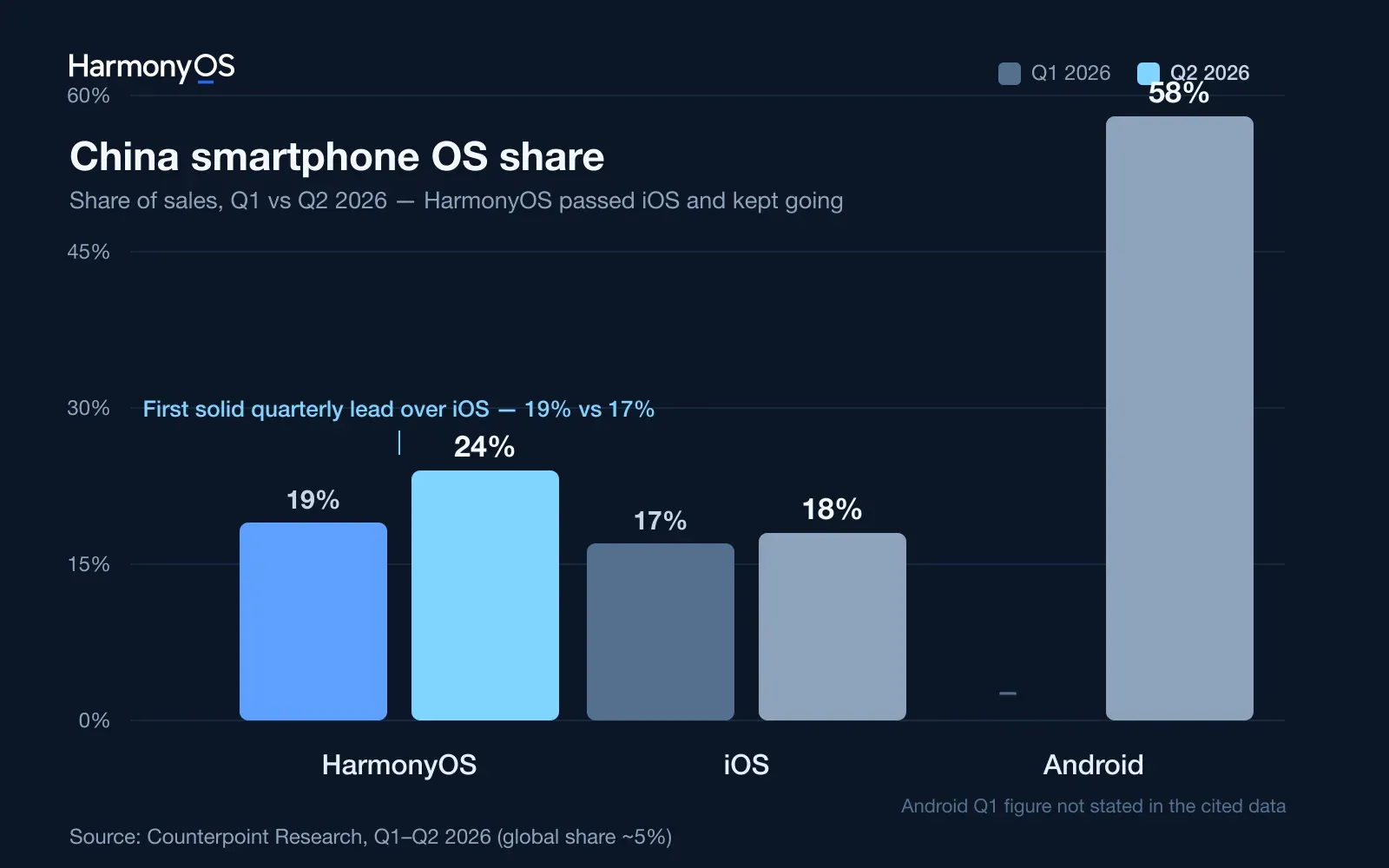
- Share: HarmonyOS has led iOS in China for two straight quarters (24% vs 18% in Q2, per Counterpoint) — the first third platform with real mass since BlackBerry.
- Hardware: Huawei holds 71.8% of China foldables and the Pura X View wide-screen phone outsold the iPhone 17 Pro Max in its launch week. The user base turns over faster than most teams assume.
- The gap: Apps covering 99.9% of Chinese user time are native; almost no international consumer apps are. Your domestic competitors ship three-platform; your international peers haven’t shown up.
- The ask: Pure HarmonyOS removed AOSP — this is a port, not a compatibility test. Flutter teams have the cheapest path; everyone else should start with a dependency audit, not a schedule.
How big the HarmonyOS market is now
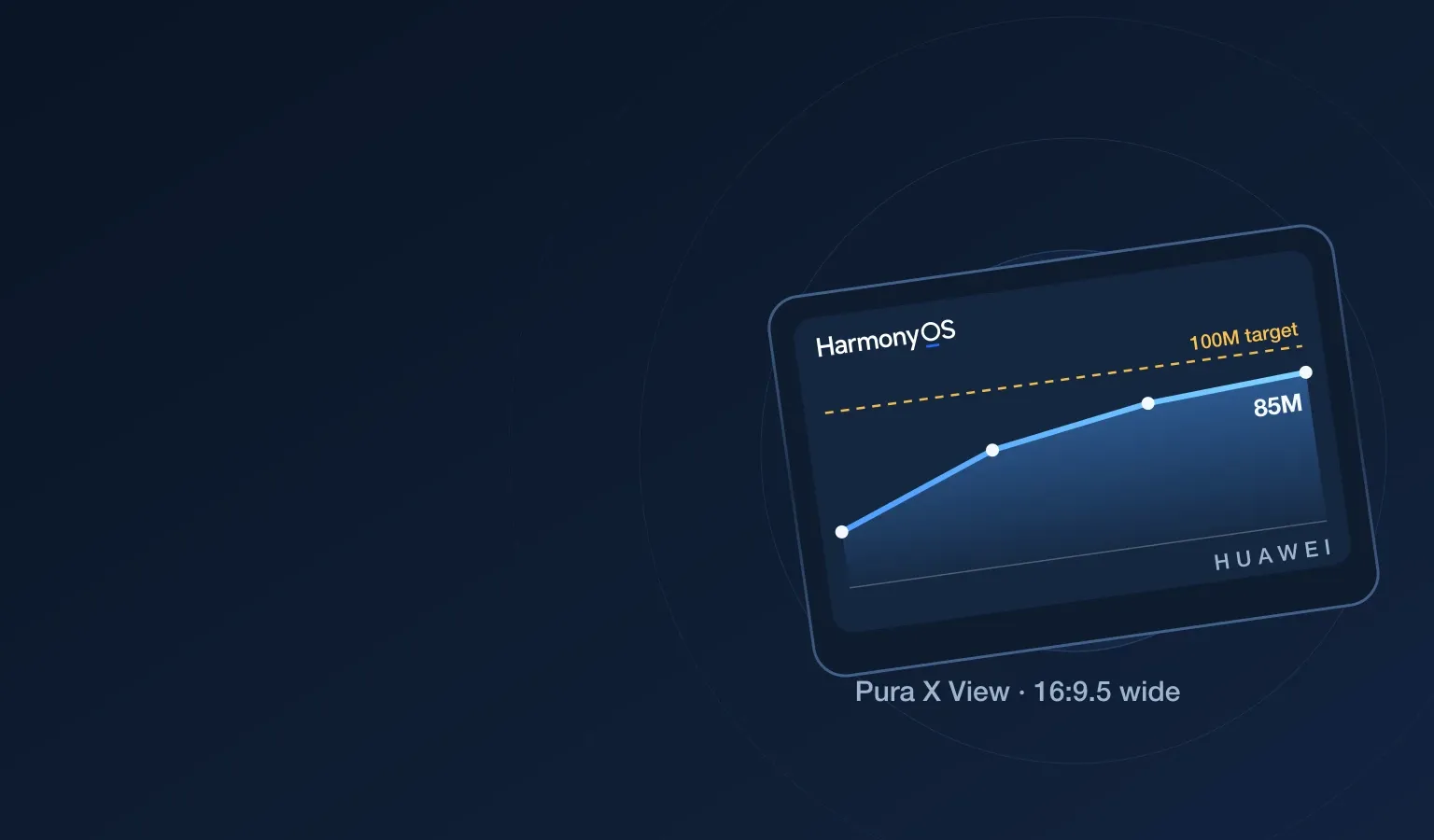
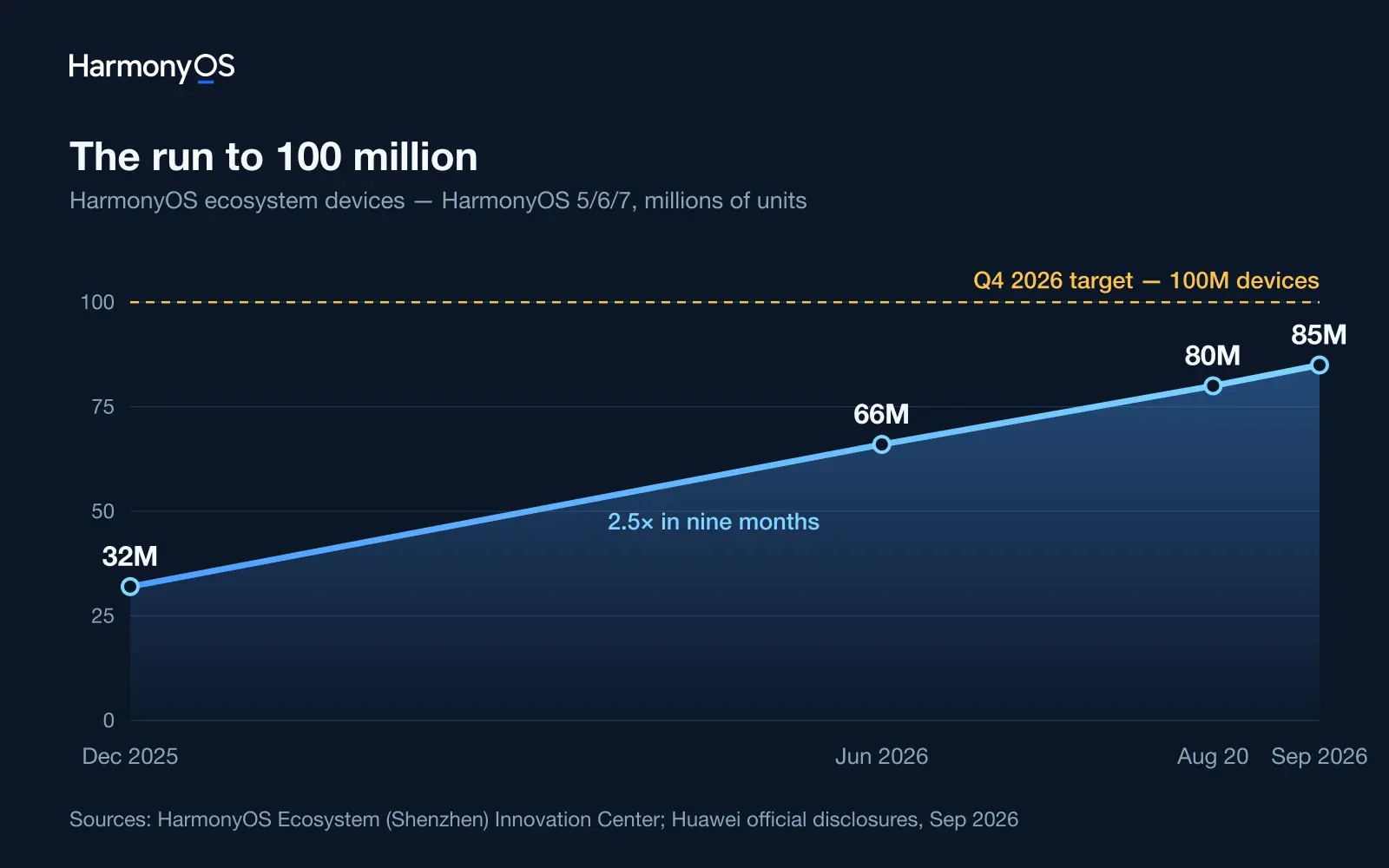
Devices first. In mid-September, the HarmonyOS Ecosystem (Shenzhen) Innovation Center disclosed that devices running HarmonyOS 6 and 7 have passed 85 million, with roughly 170,000 new activations per day. Huawei’s target for the year is 100 million by Q4 — at this pace, that’s not in doubt.
The growth curve matters more than the absolute number. In December last year, HarmonyOS 5/6 devices stood at 32 million. At the developer conference in June: 66 million. August 20: 80 million. Mid-September: 85 million. That’s two-and-a-half-fold growth in nine months, and the slope is steepening.
On share, Counterpoint has HarmonyOS at 19% of China’s smartphone OS market in Q1 — its first solid quarterly lead over iOS at 17% — rising to 24% in Q2, with iOS at 18% and Android at 58%. Globally it sits around 5%. On August 26, an MIIT briefing at the State Council Information Office made it official: the world’s third-largest mobile operating system. After BlackBerry died, this is the first third platform with real mass.
Ecosystem-side figures (Huawei official, August 2026):
| Metric | Figure |
|---|---|
| Native HarmonyOS apps | 100,000+ |
| Apps and atomic services available | 400,000+ |
| Registered developers | 11 million+ |
Huawei’s rotating chairman Xu Zhijun offered a framework this year: 1 million users validate the base system, 10 million expose its problems, and it takes 100 million to sustain a commercial loop for developers. Before 100 million, a HarmonyOS build is pure cost; after 100 million, not having one means handing your users to someone else. That line gets crossed this quarter.
100,000 native apps, against roughly 4 million each on the App Store and Google Play — the gap is in the long tail, not the head. The daily-active head is essentially complete. What’s missing: niche tools, indie apps, and international consumer apps. For domestic developers that’s a red ocean. For international developers, it’s an unclaimed position. More on that below.
Huawei hardware is doing user acquisition for HarmonyOS
HarmonyOS device growth stopped depending on old-handset upgrades a while ago. Over the past two years, Huawei has been manufacturing upgrade reasons out of hardware form factors it keeps to itself — the wide-screen line being the most representative:
| Model | Starting price | How it sold |
|---|---|---|
| Pura X wide fold (Mar 2025) | ¥7,499 (~US$1,050) | 1.5M+ shipped in a year (IDC) |
| Pura X Max (Apr 2026) | ¥10,999 (~US$1,550) | 710K units in three and a half months |
| Pura X View wide bar phone (on sale Sep 2026) | ¥5,999 (~US$840) | 282K first-week activations |
The Pura X View went on sale September 9: 180,000 units on day one, 300,000 within five days, 282K first-week activations, at an average realized price around ¥7,000 (~US$985). In week 37 it took the #1 single-model spot across all brands, ahead of the iPhone 17 Pro Max selling in the same window, and Huawei’s weekly share of the China market hit 27% — a number not seen since 2020.
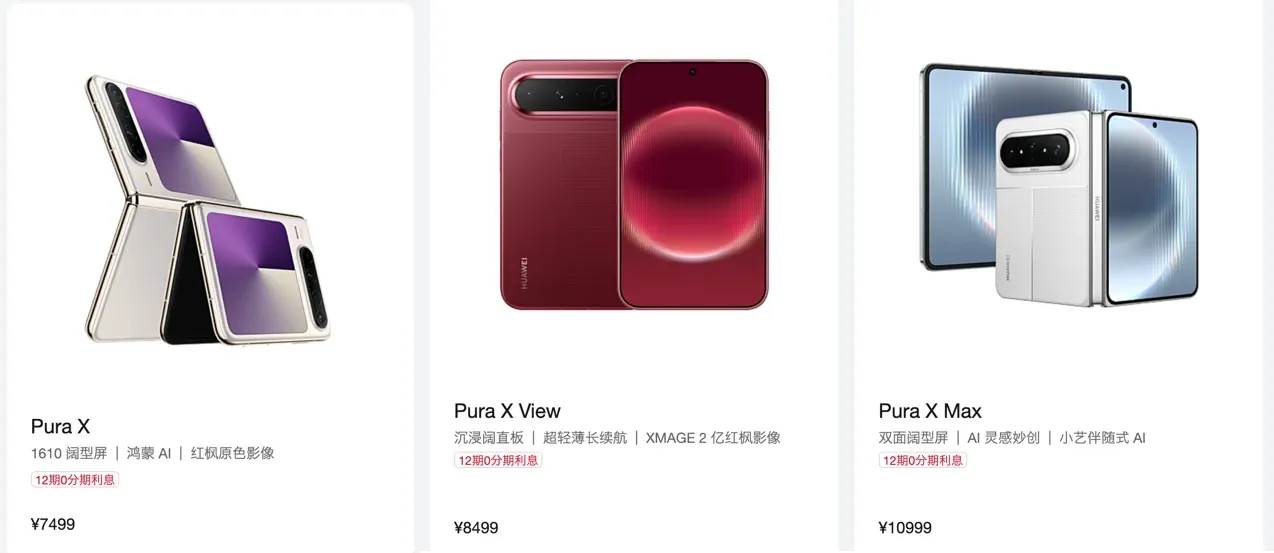
Image source: Huawei official store (VMALL) — vmall.com
Beyond the unit sales, three things say more than the sales figures themselves.
First, Huawei holds 71.8% of China’s foldable market (IDC, full-year 2025), while OPPO, vivo, Xiaomi, and Honor are all shrinking their foldable lines. Premium Android foldable users are flowing to HarmonyOS in one direction only.
Second, users pay a premium for HarmonyOS hardware — voting with their wallets. The ¥10,000+ Collector’s Edition of the Pura X Max outsells the standard model, and the Pura X View’s ~¥7,000 average price, sitting well above its ¥5,999 entry price, says buyers are choosing higher trims. In Counterpoint’s data, Huawei’s average selling price has passed Samsung’s. If you build subscriptions or in-app purchases, you know what that number means.
Third, the wide screen is not a gimmick. The Pura X View fits a 16:9.5 display into a 201-gram, 6.68mm bar-style body at a mainstream ~¥6,000 price point, and it topped the charts in its first week. It also ships with HarmonyOS 7 — the first device to leave the factory with it. For app people, the implication is concrete: a wide-aspect layout is now a mandatory line on your adaptation checklist.
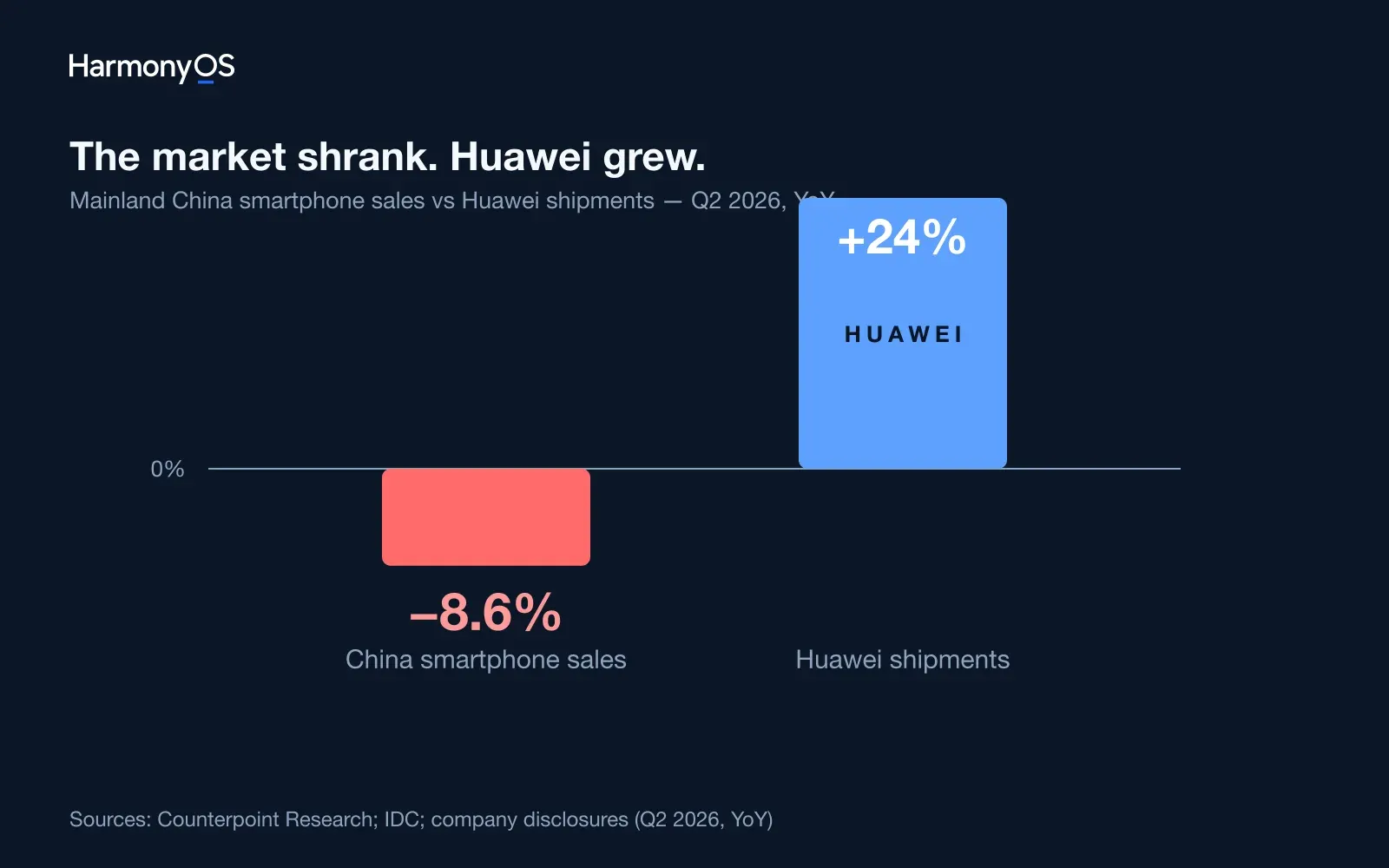
For contrast, look at the overall market: China smartphone sales fell 8.6% year over year in Q2, while Huawei shipments grew 24%. The market is shrinking; HarmonyOS is growing. The user base is turning over faster than most people assume.
Where app adaptation actually stands
Among China’s major developers, the “does it exist” phase is long over; the competition is over polish. The HarmonyOS build of WeChat shipped in January 2025 and has released 200+ versions in 500 days, with Channels and livestreaming at feature parity across Android, iOS, and HarmonyOS. Douyin, Alipay, Meituan, Taobao, JD, and WPS Office have all completed deep native adaptations and started building exclusive features on top of HarmonyOS system capabilities. The official line is that the apps accounting for 99.9% of user time are all present. The weak spot is games: most domestic mid- and heavy-core titles have no native build yet and are held up by Unity and Cocos HarmonyOS exports.
International apps are a different picture:
| Status | Representative apps |
|---|---|
| Natively available | Almost exclusively Chinese top apps |
| Running in a container | WhatsApp, YouTube, Netflix, Spotify, Uber |
| Entirely absent | Most international banks; Google’s own services |
The “container” means schemes like Easy Abroad and DroiTong, which wrap an Android environment inside HarmonyOS to run overseas apps. They run. But notifications get dropped, resolution gets downgraded, and moving files in and out is a struggle. Acceptable as a user-side stopgap; not acceptable as a product state.
Put the last two sections together: 85 million devices with demonstrated spending power, and international app distribution close to a vacuum. Your domestic competitors have already shipped three-platform. Your international peers haven’t shown up. Huawei is anxious about this too — at its ecosystem conference it named “convincing developers to support a third platform” as the first of its two biggest challenges, and the migration tooling and incentives are all tilting toward developers. A window where the platform needs developers more than developers need it opens exactly once in an ecosystem’s lifecycle.
How to port, and where it hurts
One premise first: pure HarmonyOS (5/6/7) has removed the AOSP code entirely. Android APKs neither install nor run. So “adapting to HarmonyOS” is not a compatibility test — it is a genuine rewrite or port. A lot of international vendors delay because they still believe it’s “change the package name and resubmit.”
The path depends on your team’s starting position; there is no standard answer. Teams with existing Flutter assets have the lowest cost: flutter create --platforms ohos generates the HarmonyOS host project, the official adaptation layer supports Flutter 3.x, and ordinary business pages, lists, and animations all run; for heavy custom-drawing scenes, decide after on-device stress testing. React Native has the community-maintained RNOH; uni-app goes through UTS plugin bridging — both less mature than Flutter. Game teams should go straight to Unity’s and Cocos’s HarmonyOS exports. Teams starting from nothing, or treating China as a strategic market, should go native with ArkTS and ArkUI: the language is TypeScript-based, and the declarative UI belongs to the same school as SwiftUI and Compose, so teams with a frontend background come up to speed quickly.
Also worth knowing: Huawei has been pushing an AI-assisted migration toolchain this year — code analysis, automated conversion, and dual-platform screenshot-diff validation, all usable today. Before you start, run a project assessment with it and find out what fraction of your codebase converts automatically and what fraction needs hand rewriting. That ratio directly determines your quote and your schedule.
What actually eats the time is the list of pitfalls below, ordered by how much pain they have caused across our projects:
- GMS-to-HMS replacement. Every module that touches a Google service gets rewritten: Firebase push becomes Push Kit, Google Maps becomes Map Kit (stacked with AutoNavi or Baidu compliance maps for China), Google Sign-In becomes Huawei ID or a Chinese phone-number flow, and Play Billing becomes Huawei IAP. The deeper your Google dependency, the bigger this block — our Firebase alternatives for China guide maps the same dependency set. No shortcut exists.
- Third-party SDK gaps. HarmonyOS’s third-party library market is still under construction, and many common libraries have no HarmonyOS version. Audit your dependency manifest before you start and confirm a replacement for each item. Discovering mid-build that a core feature has no library is the most expensive way to fail.
- App model refactor. Android’s Activity/Fragment maps onto HarmonyOS’s Ability model, and declarative-UI state management is a different mental model from imperative views. Java/Kotlin teams need schedule allowance for the learning curve.
- Legacy data migration. SharedPreferences and SQLite move to HarmonyOS’s Preferences and relational database; how existing users’ data comes along needs its own design.
- Permissions and listing compliance. HarmonyOS outright bans nine categories of unreasonable permissions, with transparent call tracking throughout. Listing has its own documentation set — permission declarations, a privacy dialog, signing certificates, and the app manifest — alongside the standard China-entry items like software copyright registration and mobile app filing. We have seen more than one team develop smoothly and then stall on review paperwork.
- The multi-device test matrix. Phone, tablet, foldable, wide bar, car head unit, watch — plus the 16:9.5 aspect ratio. The test surface is far larger than in the two-platform era; put it in the schedule honestly.
One revenue-share point needs clarifying: “AppGallery’s 100% first-year share” was a 2019–2020 limited-time acquisition policy that expired more than five years ago. The standard split today is 70/30 — the same as Google Play and the App Store — 15% on subscriptions, and the developer account is free. The value of listing on AppGallery is reaching the 580 million monthly actives that Google Play cannot, not a commission discount. And in-app purchases in the China region must run through Huawei’s billing; you cannot route around it.
One port, two markets
The default assumption in most international teams is “HarmonyOS is a China-only special; supporting it means maintaining a second codebase for one country.” That assumption started falling apart this year.
At the HarmonyOS ecosystem conference in August, Xu Zhijun said the quiet part out loud: it is going overseas. Pilots first, in countries and regions where conditions allow, then a conversation about a full consumer rollout — with the stated goal of “giving the world a second choice.” The same month, MIIT confirmed that OpenHarmony ecosystem devices exceed 1.35 billion, counting phones, car head units, home appliances, and industrial equipment.
The distribution channel is already global. AppGallery covers 170+ countries and regions with over 580 million monthly actives. Regional leaders like Grab, Keeta, and ZenHotels listed long ago. The Middle East, Southeast Asia, and Latin America — markets with low Google dependence — are the obvious pilot candidates.
So the ArkTS or Flutter-ohos codebase you are weighing serves more than 85 million devices in China. It is also your early ticket to wherever HarmonyOS lands overseas. An Android build defends China; a HarmonyOS build collects on both ends. For companies that want both “into China” and “into emerging markets,” it is the same R&D spend monetized twice.
Can overseas HarmonyOS actually run GMS?
Every international client asks this. Here is the evidence we found, laid out by system version:
| System | GMS status |
|---|---|
| Current overseas retail models (4.3 / EMUI) | No official license; microG and similar workarounds |
| China-market 4.x and below | Hackable, but banking apps won’t |
| Pure HarmonyOS (5 / 6 / 7) | Not natively; the Easy Abroad container works |
Three conclusions. First, the rumor that “overseas HarmonyOS ships with the full Google suite out of the box” is false. Huawei has not held a GMS license since 2019, and as of July this year that had not changed. Huawei’s own developer Q&A from this May says it plainly: Google Play Services Auth is supported only up to HarmonyOS 4; from 5.0 onward, it is gone.
Second, “running GMS-dependent apps on a HarmonyOS device” is true. The officially endorsed route is Easy Abroad, already listed on Huawei AppGallery; the container provides GMS support, and Gmail, Google Maps, YouTube, and WhatsApp run. Third-party options like GBox work similarly — with the same flaws: delayed notifications, degraded picture quality, restricted file transfer.
Third, what this means for you as a developer: a GMS dependency is neither a valid excuse to skip HarmonyOS, nor something you can leave to users “figuring out with Easy Abroad.” The container experience cannot carry a first-line product. The serious move is mapping your GMS dependencies to HMS — pitfall #1 above. The good news: Huawei is more anxious than you are, and the tooling, incentives, and overseas pilots are all tilting toward developers.
If it were my call, here’s the order I’d work
Clients often ask us to skip to the conclusion. If your management wants a HarmonyOS plan next week, this is the order we would work in — the same sequence we run in publish an app in China engagements.
Spend a few days on a dependency audit first. Two lists: every GMS call in your app, and every third-party SDK — each annotated with its HarmonyOS-side replacement and an effort estimate. This step takes days, and it determines whether every number after it is trustworthy. Scheduling without this table is guessing.
Then pick the path that matches the cards in your hand. Teams with Flutter assets: take the ohos branch and build a pilot of your core flow; two weeks validates most of your assumptions. Pure-native two-platform teams: run Huawei’s AI migration tool for an assessment, look at the auto-convert versus hand-rewrite ratio, and only then decide whether to build in-house or outsource.
Aim the first release at wherever money changes hands. Subscription tools, productivity, finance, education, or the China build of your game. The Pura X View’s ¥7,000 average price and a ten-thousand-yuan Collector’s Edition outselling the standard model have re-confirmed this user pool’s willingness to pay — and not one comparable international app has shown up. Ship the monetizable modules first; community and content features can follow.
Start the compliance paperwork in parallel with development, not after it. Permission declarations, privacy policy, signing certificates — plus the standard China-entry items like software copyright registration and ICP filing. These cycles run longer than most people expect; this year we have watched several teams finish development and stall in review.
Last, do the math with the overseas pilot in it. A HarmonyOS build is not a China-only cost line. It is the entry ticket to 85 million devices at home plus the first wave of the Middle East and Southeast Asia. Amortized over one market or over two, the business case can come out with exactly opposite conclusions.
The facts as of filing: the HarmonyOS device base crosses 100 million this quarter, share has led iOS for two consecutive quarters, China’s major developers are shipping three-platform, and the international aisle is still empty. Once the platform is no longer short of developers, the support and the upside get taken back. A position like this appears once in an ecosystem’s lifecycle. The last time was the App Store, in 2009.
Sources
The sources doing the heaviest lifting in this piece:
- Counterpoint Research via Dataconomy — HarmonyOS becomes the world’s third-largest mobile OS (Q2 2026 China share: 24% vs iOS 18%)
- IDC foldables data via ChinaBiz Insider — Huawei tightens its grip on China’s foldable market (71.8%) as rivals retreat
- Sina — Pura X View first-week activations reach 282K at ~¥7,000 average price, taking the week-37 single-model crown
- AnTuTu — Pura X passes 1.54M units; Pura X Max at 580K
- Tencent stock terminal — cumulative HarmonyOS activations pass 80.1 million, sprinting to the 100-million target
- CNR — HarmonyOS NEXT native apps arrive, led by the WeChat listing
- Huawei developer Q&A (May 2026) via Sina — Google Play Services Auth is supported only up to HarmonyOS 4
- HarmonyOS Cool — the Easy Abroad container for running GMS-dependent apps
- Vmobify — AppGallery’s current 70/30 split, and the expired “100% first-year share” policy
- Huawei Cloud community — choosing a Flutter-to-HarmonyOS migration approach
Note on data quality: Pura-series sales and activation figures come from channel sources and blogger disclosures and are not officially audited. Device, app, and developer counts are Huawei official figures and are labeled as such. Where the two classes of data disagree, both are shown side by side — we have not made the choice for you.
Trademark notice. HarmonyOS, HUAWEI, Pura, Pura X, Pura X Max, Pura X View, AppGallery, HMS, Push Kit, Map Kit, and Easy Abroad are trademarks of Huawei Technologies Co., Ltd. Android, Google Play, Google Maps, and Firebase are trademarks of Google LLC. iOS, App Store, and iPhone are trademarks of Apple Inc. Counterpoint and IDC are trademarks of their respective owners. This article is independent editorial analysis published by Chinaready; it is not commissioned by, endorsed by, or affiliated with Huawei, Google, or Apple. Brand names, device names, and the HarmonyOS wordmark are used for identification purposes only.