Alibaba.com China — pick B2B, Tmall, or AliExpress
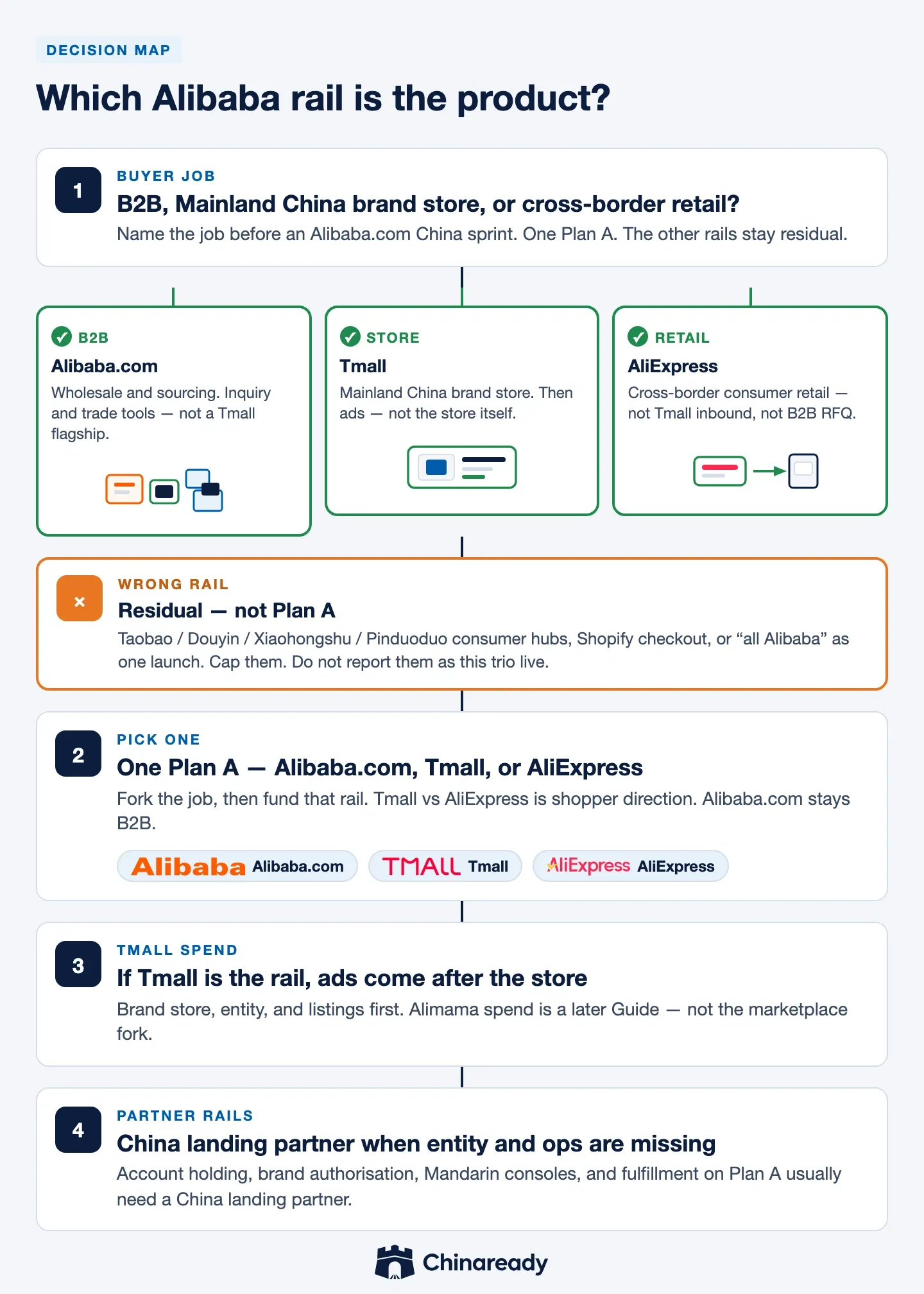
Alibaba.com China is a rail choice. B2B uses Alibaba.com; a Mainland China brand store uses Tmall; cross-border retail uses AliExpress. Pick one Plan A. Ads and Shopify remaps are different jobs.
Alibaba.com China is a rail choice, not one marketplace SKU. Fork the job, then pick one Plan A: B2B wholesale on Alibaba.com, a Mainland China brand store on Tmall, or cross-border retail on AliExpress. Keep the other two residual. This is not a Tmall ads rewrite and not a Taobao consumer-hub clone. Shopify is not an Alibaba rail — remap that storefront on Shopify in China.
What Alibaba.com, Tmall, and AliExpress actually are
Hard names your commerce plan will use:
- Alibaba.com — Alibaba Group’s global B2B marketplace. Buyers source; suppliers list, inquire, and trade. Group description: Alibaba.com. Seller onboarding: How to start selling on Seller Central. English storefront and RFQ tools do not create a Tmall flagship.
- Tmall — Mainland China brand-store rail. Brands sell to shoppers in Mainland China on a flagship or authorised store. Group description: Tmall. Consumer entry: tmall.com. Tmall Global, if you use it, is still this rail — inbound to Mainland China shoppers — not AliExpress.
- AliExpress — Cross-border retail to consumers outside Mainland China. Group description: AliExpress. Consumer entry: aliexpress.com. A Choice-style retail program is still AliExpress, not a Tmall brand store.
- Tmall vs AliExpress — Shopper direction. Tmall = Mainland China brand retail. AliExpress = international consumer retail. Mixing them reports “we launched Alibaba” while the wrong buyer never converts.
- Not Taobao / Douyin / Xiaohongshu / Pinduoduo — Those consumer search-shop and content-commerce rails live on the China consumer platform map. Taobao seller ads are a different spend job: Taobao ads.
- Not Shopify — An independent Shopify checkout is not one of these three rails. Shopify in China is the storefront-reach fork.
- Common myth — “Open Alibaba.com and we are on Tmall.” B2B inquiry is not a Mainland China brand store. Twin myth: AliExpress listings as a Tmall flagship.
Vocabulary first. Next: what must be true before a rail is Plan A.
What must be true before you name a rail
Missing a named buyer job stops your product team before an “Alibaba for China” sprint is real work.
| Precondition | Why your process stalls |
|---|---|
| Buyer job locked — B2B wholesale vs Mainland China brand store vs cross-border retail | All three rails are staffed as one Alibaba.com China launch; none finish |
| One Plan A named — Alibaba.com, Tmall, or AliExpress | Residual rails crowd the critical path; ops cannot tell which console is live |
| Honest store class — B2B storefront ≠ Tmall flagship ≠ AliExpress retail | HQ reports “Alibaba is live” on the wrong buyer |
| Entity / partner path that can hold the chosen rail | Company verification and settlement commonly expect Chinese business-license or authorised-ops rails, especially on Tmall |
| Brand / IP pack when Tmall is Plan A — name, mark, authorisation | Store open waits on proof the platform expects — trademark in China |
| Fulfillment and settlement named for that rail | Listings without stock, logistics, or remittance are not a store |
| Owned web scoped only if needed beside the store | A China-reachable site is a separate job — website vs WeChat |
| Ads scoped after the rail if Tmall is Plan A | Alimama spend before a brand store burns prepaid balance — Tmall ads |
Product teams usually cannot treat “join Alibaba, then figure out Tmall vs AliExpress later” as the Mainland China plan. Naming the rail is the floor.
Which Alibaba platform is Plan A
| Stage | Decision / outcome |
|---|---|
| 1. Name the buyer job | B2B sourcing / wholesale, Mainland China brand retail, or cross-border consumer retail? |
| 2. Pick one Plan A | Alibaba.com (B2B) · Tmall (Mainland China brand store) · AliExpress (cross-border retail) |
| 3. Park the other two as residual | Cap them. Do not report residual listings as the China store |
| 4. If the job is none of these | Remap. Taobao / Douyin / Xiaohongshu / Pinduoduo → consumer platform map. Independent checkout → Shopify in China or a China-reachable owned storefront |
| 5. Lock entity, brand, and ops on Plan A | Who holds the account, trademark / authorisation, admin phones, fulfillment, and exit |
| 6. If Tmall is Plan A and you will spend | Open the brand store first, then Tmall ads. Taobao seller media is not a substitute: Taobao ads |
| 7. If a China-reachable web still sits beside the store | Treat that origin as its own fork — website vs WeChat |
Hard gate — one Plan A, two residual
Necessity: confusing these three jobs wastes the quarter — either you underfund the rail that actually holds the buyer, or you staff Tmall, AliExpress, and Alibaba.com as if they were one SKU.
| Job | Plan A | What must already be true |
|---|---|---|
| B2B wholesale / sourcing | Alibaba.com | Buyer is a business; inquiry and trade tools match the offer; Tmall flagship is not required for this job |
| Mainland China brand store | Tmall | Shoppers are in Mainland China; brand-store type, entity or partner, and IP pack are in motion |
| Cross-border retail | AliExpress | Shoppers are outside Mainland China; retail checkout — not B2B RFQ, not Tmall |
| Taobao / Douyin / Xiaohongshu / Pinduoduo consumer hub | Not this trio | Use the consumer platform map |
| Independent Shopify (or peer) checkout | Not this trio | Shopify in China |
| “All Alibaba platforms” as one launch | Myth as Plan A | One named rail; the rest residual |
Domestic wholesale on 1688 is a different B2B job from Alibaba.com. Do not treat a 1688 account as Alibaba.com China launched.
Confirm live merchant gates on the official entries above. This Guide does not reprint apply click-paths.
Why mixing rails kills the store plan
Alibaba.com treated as Tmall → no Mainland China brand store. B2B inquiry and Trade Assurance-class tools do not list a flagship for shoppers on Tmall.
Tmall vs AliExpress reversed → the wrong shopper. Tmall converts in Mainland China. AliExpress converts international retail. A Tmall Global inbound path is still Tmall; it is not AliExpress export retail.
Ads before the Tmall rail → spend with nowhere to convert. Tmall ads assume a brand store that can list, fulfill, and settle. Taobao ads assume a seller rail — not a Tmall flagship rename.
Shopify kept as the Alibaba plan → wrong storefront class. Shopify checkout is not Alibaba.com, Tmall, or AliExpress. Remap on Shopify in China.
Taobao consumer hub counted as this trio → wrong map. Search-shop and content-commerce order sits on the consumer platform map.
Trademark skipped on a Tmall Plan A → store open stalls. Brand proof is a gate, not a polish pass — trademark in China.
Owned web ignored or over-scoped → two products collide. If you still need a China-reachable site beside the store, that is a separate origin decision — website vs WeChat.
What stalls teams that treat Alibaba as one SKU
- Platform-name thinking — Product treats “Alibaba” as a geo toggle before which Alibaba platform is named.
- Alibaba.com as the China storefront — A B2B membership is reported as Tmall live.
- Tmall vs AliExpress as a price tier — Cheap vs premium, instead of shopper direction.
- Ads-first Tmall — Creative and Alimama booked before brand-store entry.
- Shopify-plus-Alibaba mashup — HQ Shopify admin plus a few AliExpress SKUs reported as Mainland China brand retail.
- Consumer-hub dump — Taobao, Douyin, Xiaohongshu, and Pinduoduo added because “China ecommerce,” without a Plan A on this trio.
- HQ laptop QA — Testers outside Mainland China never see Tmall shopper or AliExpress export reality, so the ticket never opens.
- No owner for the fork — The plan stalls because nobody owns Plan A vs residual — only “launch on Alibaba.”
What “fixed” means: One named rail is Plan A (Alibaba.com, Tmall, or AliExpress); the other two are capped residual if they exist; Tmall ads start only after Tmall is the rail; Taobao / Douyin / Xiaohongshu / Pinduoduo are not counted as this trio; Shopify is not counted as an Alibaba rail; trademark and entity sit on the Tmall path when that is Plan A; any owned web beside the store is a named separate job. “We have Alibaba” with three half-open consoles is not fixed.
China landing partner when the rail is the product
Most product teams exploring Mainland China entry need a China landing partner once they name the rail — to hold or operate the chosen Alibaba.com, Tmall, or AliExpress account path, clear entity and admin verification, assemble brand authorisation for a Tmall store, run Mandarin consoles, and stand up fulfillment and settlement that match that Plan A. Your team still owns catalog, pricing, and which rail wins the shortlist; the partner path makes that rail executable when those ops are not already in-house. Keeping residual listings on the other two platforms does not remove the need for that China landing partner on Plan A.
What we can offer?
Alibaba.com China work is a which-rail decision before any “open Alibaba and scale” sprint. Chinaready helps your product team pick one Plan A — Alibaba.com, Tmall, or AliExpress — and clear the entity, brand, and ops rails that make that store real:
- China Readiness Assessment — Decide which Alibaba platform is Plan A, which two stay residual, and which entity, trademark, fulfillment, and (if Tmall) ads gates sit on the critical path before a store date.
- China Access Acceleration — Keep any China-facing pages beside the store reachable from Mainland China vantage so brand and conversion paths do not die on an offshore-only site while the marketplace rail is opening.
- China Product Hosting — Place a China-reachable owned origin, when you still need one beside Tmall or Alibaba.com, where entity consistency and ICP adjacency stay coherent with the store offer.
- Mobile App Distribution — Align Mini Program or app sell-in with the chosen marketplace rail — not mistake a WebView of Alibaba.com for a Tmall brand store.
Contact us when you need one Alibaba rail named before you staff another “sell on Alibaba” sprint.
Frequently asked questions
Which Alibaba platform is the product for China?
Name the buyer job first. B2B wholesale and sourcing is Alibaba.com. A Mainland China brand store is Tmall. Cross-border retail to shoppers outside Mainland China is AliExpress. Pick one Plan A. Do not staff all three as one Alibaba.com China launch.
What does Alibaba.com China actually mean?
Alibaba.com is Alibaba Group’s global B2B marketplace — inquiries, storefront, and trade tools for buyers and suppliers — not a Tmall flagship and not AliExpress retail checkout. Official entry is alibaba.com. Seller onboarding lives on Seller Central. A working Alibaba.com account is not proof that Tmall or AliExpress is live.
How should we read Tmall vs AliExpress?
Tmall vs AliExpress is a shopper-direction fork, not a brand-vs-cheap rename. Tmall is the Mainland China brand-store rail (shoppers in Mainland China). AliExpress is cross-border retail to international consumers. Tmall Global, if you use it, is still Tmall as the rail. AliExpress does not replace a Tmall brand store.
Is Alibaba.com a Mainland China brand store?
No. Alibaba.com is B2B. Ordinary Mainland China brand retail sits on Tmall. Taobao search-shop, Douyin, Xiaohongshu, and Pinduoduo are a different consumer-platform order. Shopify is not an Alibaba rail.
Do we run Tmall ads as soon as we pick Tmall?
No. Pick Tmall as the rail first — brand store, entity or partner path, listings, and fulfillment. Tmall ads and Alimama spend come after that rail exists. Do not buy retail media on a store you have not opened.
Can product teams finish an Alibaba rail without Mainland China ops?
Usually no. Entity and admin rails, brand authorisation, Mandarin consoles, settlement, and fulfillment sit on ops most global teams lack. That is when a China landing partner becomes the realistic path.
Insights
Other similar insights
Part of the Third-party dependencies cluster — every guide in the cluster, one page.