

Apple App Store China — filings, ISBN, and territory gates
A live global App Store listing does not guarantee Mainland China availability. App filing, category risk, and the game ISBN path decide whether your title can ship — and Android multi-store distribution is a separate track.
A global App Store listing is not a Mainland China launch. Apple’s China storefront is a regulated, localized channel: category risk, local filings, game ISBN rules, and operational readiness decide availability. This Guide is for publishers — not a consumer tutorial for switching Apple ID regions.
Video handbook
Short YouTube series on the Apple App Store in Mainland China — regional storefront, accounts and payments, iCloud residency, publishing structures, and launch readiness. Full episode list and slide decks live on the handbooks hub.
- Full series on Chinaready handbooks — playlist, episode links, and PPT decks
Episodes:
| Ep | YouTube Title | Handbook |
|---|---|---|
| 1 | What the China App Store is | PPT |
| 2 | Accounts, payments, and iCloud residency | PPT |
| 3 | Publishing structures and launch readiness | PPT |
What Apple’s China App Store means for publishers
Hard names your program will use (rewritten for the publish decision — not for end-user account switching):
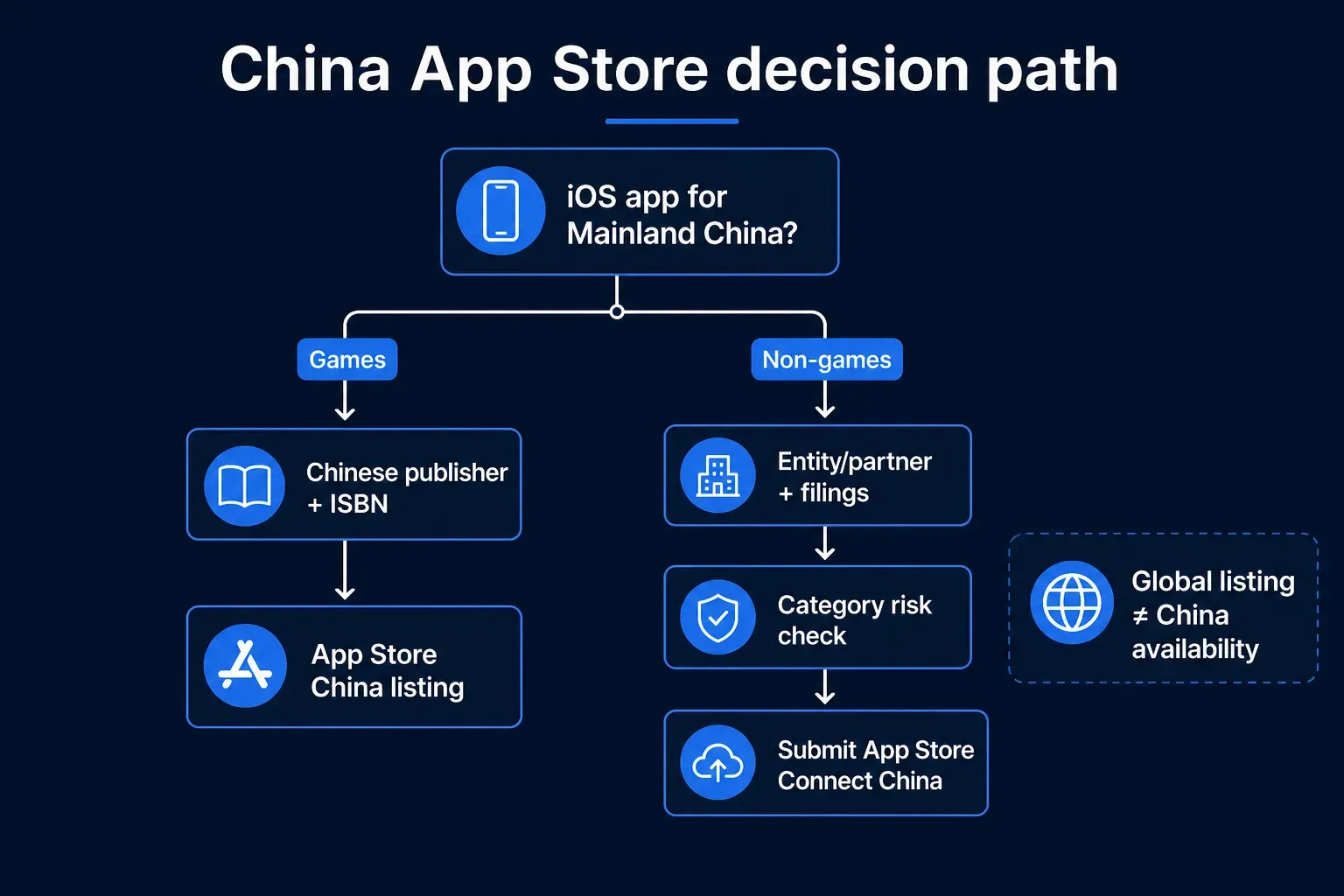
- Regulated channel, not a locale — Mainland China availability is a compliance and territory decision. Global live ≠ China available.
- Not the consumer “China Apple ID” problem — Guides about creating a China-region Apple ID to download WeChat or Douyin answer a different job. This Guide is for shipping your product into Apple’s China storefront.
- Category risk dominates — Productivity / travel / education / lifestyle / brand commerce often clearer; social, messaging, news, VPN-like, crypto, generative AI, and games face deeper review and lower odds.
- Games → ISBN path — Monetized titles generally need Chinese publishing approval before durable China App Store presence. Spine: China game ISBN and Publish a game in China.
- Filings and ops still apply — App filing / registration materials, Chinese metadata, privacy disclosures, and support language sit beside App Review — not after it.
- Market signal (order of magnitude) — Apple does not publish China App Store revenue alone. Public proxies (global Services vs Greater China net sales) show mixed signals: Services strength globally alongside pressure on Apple’s broader Greater China business. Use that as context, not a P&L for your SKU.
Vocabulary first. Next: which decisions you lock, and where your process stalls.
Before you flip China territory
Missing any of these stops your product team before an honest China territory flip.
| Precondition | Why your process stalls |
|---|---|
| Defined Chinese iPhone audience — premium/subscription/enterprise segment named | “Launch everywhere” without audience fit wastes compliance effort |
| Category risk read — productivity vs social / messaging / news / VPN / AI / games | High-risk categories need deeper design and often lower odds |
| Entity / partner path where filings or licenses require it | Many launches are market-entry tracks, not locale toggles |
| Filing & license path — app filing / ICP-related needs; game ISBN if monetized game | Missing approvals drive non-availability and removal waves |
| Chinese ops pack — metadata, privacy disclosures, support language, content workflow | Translation-only packages fail review and post-launch duties |
| Backend reachability plan — Mainland China users can complete auth and core journeys | A perfect listing with overseas-only APIs is still a failed product |
Public reporting since 2021 describes a tighter environment: stricter app registration and game approvals; higher scrutiny on generative AI, messaging, VPNs, news, and sensitive content; and a China App Store that is less useful as a default extension of a global listing.
Seven decisions for China iOS enablement
| Stage | Decision |
|---|---|
| 1. Audience fit | Do Mainland China iOS users justify the compliance work? |
| 2. Category gate | Lower-risk vs high-risk content classes |
| 3. Game vs non-game | Monetized games → ISBN / Chinese publishing path before durable listing |
| 4. Entity & filings | Local entity/partner and app filing / registration materials as required |
| 5. China ops package | Chinese metadata, privacy, support, moderation, payment model review |
| 6. Submit & territory | App Store Connect China availability only after the path above is real |
| 7. Operate | Updates, SDK allowlist, content policy, removal/appeal ownership |
Launch when
- Target customers include premium urban Chinese iPhone users as a defined segment.
- Category risk is workable and local filings/licenses/partner support exist or can be obtained.
- Chinese-language materials and support can be staffed.
Be careful when
- The app includes social posting, messaging, live streaming, news, VPN, political or religious content, crypto, maps, generative AI, or games.
- Sensitive personal information, children’s data, or overseas-only backends dominate the journey.
- Chinese customer support or local legal documentation cannot be provided.
Do not treat China as another locale
Localization for Mainland China commonly includes infrastructure, compliance, payments, support, content policy, data handling, and business-model review — not translation alone. Hong Kong, Taiwan, Singapore, Japan, or Southeast Asia launches do not substitute for Mainland China game or category compliance. Android OEM fragmentation is a separate track — the app stores in China map frames the surfaces, and China Android app stores covers the OEM first wave. The build and beta distribution tooling behind those releases is a separate question again; Landscape’s Visual Studio App Center map is a research shortlist there, not an endorsement.
Why a global listing still fails China
Global listing live → false China availability. Territory settings and local rules can keep Mainland China off even when US/EU stores ship.
High-risk category → deeper review, lower odds. Information-flow, messaging, news, VPN-like, and sensitive-content apps show higher removal or non-approval risk in public reporting.
Monetized game without ISBN path → removal-wave exposure. Paid/IAP games generally need Chinese publishing approval before durable China App Store presence.
Greater China hardware softness ≠ “ignore iOS.” Soft hardware numbers do not erase a high-value iPhone segment when audience and compliance fit.
Global Services growth ≠ China App Store green light. Aggregate Apple proxies are not your category clearance.
Listing OK + overseas-only backend → failed journeys. Store presence without Mainland China-reachable auth, APIs, or critical deps is not a launch. When that backend is a hosted platform, read it function by function rather than as one verdict — Firebase alternatives for China, by function does that for auth, database, storage, push, and functions. Sign-up and support screens deserve the same check, since an overseas captcha or form host is its own dependency (Captcha and forms in China).
Category risk and enforcement patterns
- Game licensing weight — strong monetization category in industry reporting, tightly controlled; publishers and months of lead time are normal.
- Category enforcement waves — messaging, VPN-adjacent, news, and AI apps have faced public removal or non-approval patterns; design for compliance before marketing a soft launch.
- Domestic hardware competition — Huawei, Xiaomi, vivo, OPPO, Honor, and HarmonyOS shipment trends change the hardware landscape; China iOS remains a distinct segment, not the whole phone market.
- PIPL / data / SDK debt — personal information, export, localization, and analytics providers become review and ops blockers.
- No owner for rule changes — registration, privacy, content, and AI-related requirements evolve; last year’s checklist can fail this quarter.
- Checklist theater — ICP/app filing, ISBN (if game), Chinese privacy materials, support process, IAP model, moderation, Mainland China hosting/performance, and partner needs must be owned — not pasted from a blog.
Planning question: not “launch everywhere,” but whether Mainland China iOS users justify the compliance work. For many premium apps in lower-risk categories, China iOS stays in the plan. For high-risk content, AI, media, social, VPN, crypto, and games, licensing and local execution decide.
China landing partner for App Store China
Most product teams exploring Mainland China entry need a China landing partner to clear entity, filing, category, and China App Store ops — not another longer App Store Connect tutorial. Your team still owns product and category design; the partner path makes the regulated channel executable when Mainland China rails are not already in-house.
What we can offer?
Apple’s China App Store is a regulated channel, not a locale toggle. Chinaready helps your product team decide if China iOS is worth it for your category, clear filings/ISBN/entity gates, then keep the product working after enablement:
- China Readiness Assessment — Decide go/no-go for China App Store by category risk, and name filing, ISBN (for games), and entity gates before you flip territories in App Store Connect.
- China Access Acceleration — Make Mainland China journeys work after listing — auth, APIs, and critical deps — so App Review success is not a false launch.
- China Product Hosting — Place China-critical services where iPhone users in Mainland China can complete the product path.
- Mobile App Distribution — Operate Apple China availability with release discipline that matches your Android multi-store plan when both platforms are in scope.
Contact us when you need that regulated-channel map before promising a China iOS date.
Information sources and data notes
Apple does not publish China App Store revenue as a standalone number. Use Apple global Services revenue and Greater China net sales only as official public proxies — not blended third-party app-market estimates.
Frequently asked questions
Can I publish on the Apple App Store in Mainland China from a global listing?
Not automatically. Mainland China availability depends on local compliance, category rules, and App Store Connect territory settings. A live U.S. or EU listing does not guarantee China availability.
Why do games get removed from the China App Store in large batches?
Paid games and games with in-app purchases generally need valid Chinese game publishing approval (ISBN path). Listings without the required approvals face removal waves when enforcement tightens — plan the license path before marketing a China soft launch.
How should product teams use the China App Store as a distribution channel?
Treat it as a regulated market-entry track — local entity or partner where needed, filings, Chinese metadata and support, and a documented category path — not as “add China” on a global release checklist.
Do RSS readers or messaging apps face special risk?
Yes. Apps involving information flow, messaging, news, VPN-like access, or politically sensitive content show higher removal or non-approval risk in public reporting. Expect deeper review and lower odds without a clear compliant design.
Should we still prioritize China iOS if Greater China hardware sales softened?
Often yes for premium, subscription, or enterprise-adjacent apps with a defined Chinese iPhone audience and a lower-risk category. Soft hardware numbers do not erase iOS as a high-value segment when compliance is workable.
What filings does a Mainland China App Store launch need?
The preconditions in this Guide name an app filing and registration materials path with ICP-related needs, plus Chinese publishing approval on the ISBN path when the title is a monetized game. Where filings or licenses require it, a local entity or partner sits beside them, along with Chinese metadata, privacy disclosures, and staffed support language.
Insights
Other similar insights
Part of the App distribution cluster — every guide in the cluster, one page.