
WeChat Pay apps China — merchant and entity gates
WeChat Pay apps China is a merchant and entity Decision Map — clear WeChat Pay merchant and WeChat Pay entity paths for App surfaces before SDK tickets; partner when those rails are missing.
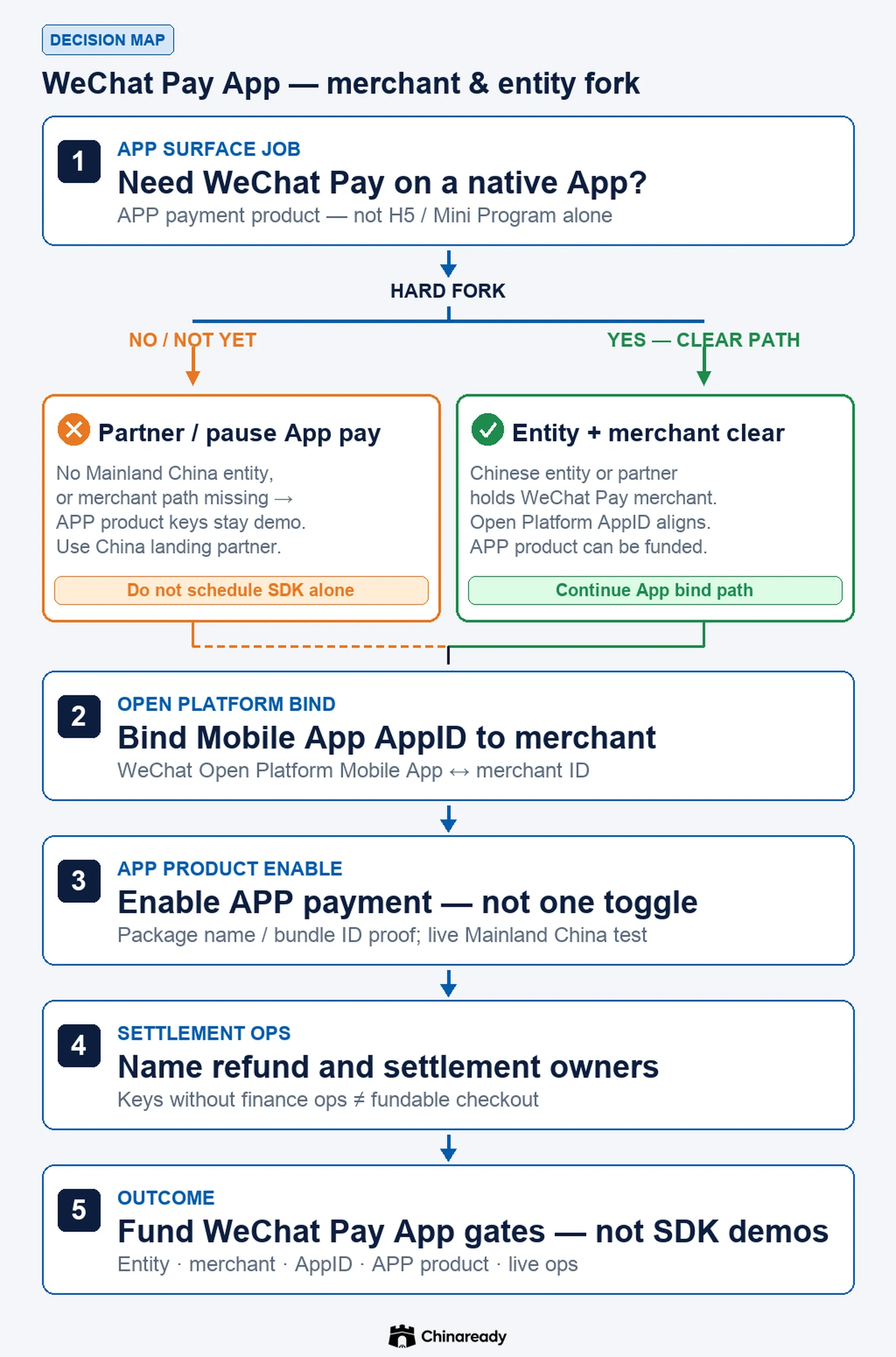
WeChat Pay apps China is a merchant-and-entity Decision Map — clear WeChat Pay merchant and WeChat Pay entity paths for App surfaces before you schedule SDKs. WeChat Pay (微信支付) APP payment is a product enablement path on WeChat Pay plus WeChat Open Platform Mobile App binding — not one overseas wallet toggle. Most product teams need a Mainland China entity or China landing-partner merchant path before production App keys are real work.
What WeChat Pay means for App checkout
Hard names your WeChat Pay App program will use:
- WeChat Pay (微信支付) — Tencent’s consumer wallet rail. Merchant docs and product intros live on WeChat Pay and the English merchant entry at WeChat Pay (EN). APP / H5 / Mini Program are separate products — shipping a native App SDK does not unlock in-WeChat journeys automatically.
- WeChat Pay merchant — The merchant account that settles funds, refunds, and disputes. Domestic onboarding and applyment guidance expect a Chinese organizing path; overseas-only Stripe / PayPal stacks are not a substitute for ordinary Mainland China App users.
- WeChat Pay entity — The Mainland China business subject (or contracted partner) that can hold that merchant account and complete legal-person / enterprise verification. No durable entity story → no durable production merchant keys.
- WeChat Pay integration apps — For native Apps: Open Platform Mobile App creation and access (iOS access guide, Android access guide), AppID ↔ merchant bind, APP payment product enablement, and package / bundle proof aligned to the same entity story.
- Sibling maps — Dual-rail WeChat Pay + Alipay sequencing: WeChat Pay Alipay China. Alipay-only App depth: Alipay for apps. Login + wallet peers (including Apple IAP): App login and payments in China.
- Common myth — “Drop the WeChat Pay App SDK after global launch.” Without entity, merchant, and AppID gates, SDKs are demos — not a fundable China App checkout plan.
Vocabulary first. Next: what must exist before App payment tickets are real work.
What must exist before WeChat Pay App work
Missing any of these stops your product team before WeChat Pay APP production APIs — not after the global payments backlog is already frozen.
| Precondition | Why your process stalls |
|---|---|
| WeChat Pay entity or China landing partner named for merchant accounts | Domestic WeChat Pay merchant onboarding and Open Platform verification need a China organizing path |
| WeChat Pay merchant applicant path locked — who applies, who settles, who refunds | Engineering finishes SDKs while legal and finance still have no merchant console |
| App surface confirmed — native APP product (not “pay somehow in China”) | Wrong product apply → keys that cannot invoke the App journey users and reviewers hit |
| Open Platform Mobile App ownership — who holds AppIDs, who binds merchant IDs | Screenshots of a sandbox do not replace AppID ↔ merchant alignment |
| SKU classification — digital goods vs physical / services; iOS vs Android | Wallet rails and Apple IAP forks collide when digital catalog items are mislabeled |
| Settlement + refund ops owner | Live launch fails when finance has no China merchant console access |
Chinese-language merchant consoles, legal-person verification, and package / bundle binding sit outside a Stripe dashboard checklist. Broader login and dual-rail context: login and payments for apps and WeChat Pay Alipay China.
WeChat Pay App integration decisions
Use this as a gate map for WeChat Pay integration apps. Stages are decisions — not SDK click-paths.
| Stage | Decision / outcome |
|---|---|
| 1. Confirm App money surface | Which native App journeys must charge with WeChat Pay in Mainland China |
| 2. Fork entity / merchant path | Mainland China entity or partner that can hold a WeChat Pay merchant account — or pause App pay until that path exists |
| 3. Bind Open Platform | Mobile App AppID(s) matched to the merchant entity (Open Platform) |
| 4. Enable APP payment product | APP product on the merchant side — separate from H5 / Mini Program |
| 5. Align store and privacy evidence | Screenshots and questionnaires match the China WeChat Pay App journey; PIPL-aware payment data handling |
| 6. Operate | Refunds, key rotation, reconciliation, dispute handling — live ops on the WeChat Pay merchant console |
iOS digital goods still need Apple IAP classification beside wallet rails — do not collapse that fork into “WeChat Pay apps China done.” Detail: login and payments Guide.
Why skipping entity or AppID bind blocks App checkout
No Mainland China entity / partner → no durable WeChat Pay merchant keys. Domestic WeChat Pay onboarding does not treat a foreign Stripe account as the China merchant path.
WeChat Pay merchant without Open Platform bind → App invoke fails. Merchant ID and Mobile App AppID must align; sandbox demos do not replace binding.
App SDK only → H5 / Mini Program still dark (and vice versa). Surface products are separate gates; users who pay in-browser or in-WeChat never hit your native SDK.
WeChat Pay entity unclear → settlement and refunds stall after listing. Finance cannot reconcile when merchant ownership is ambiguous — stores and users escalate.
Global card-first checkout → empty Mainland China App UX. Ordinary users expect WeChat Pay (and usually Alipay) first; cards are not the default consumer path.
Treating dual-rail dual-SDK work as this Guide’s finish line → Alipay still empty. This map clears WeChat Pay App depth; Alipay remains a separate merchant and open-platform stack — see Alipay for apps and the dual-rail Guide.
Where WeChat Pay App programs stall
- Treating WeChat Pay integration apps as one backlog ticket — entity, merchant, Open Platform, APP product, and settlement ops are separate gates.
- Starting with SDK samples before WeChat Pay entity and merchant decisions — the stall is usually applicant path and product enablement, not API syntax.
- Promising “WeChat Pay App in two weeks” without naming who holds the merchant account — diligence settlement, refund, and reject handling before dates go on a board slide.
- Ignoring package / bundle ID proof — APP product enablement fails when the signed binary does not match Open Platform registration.
- Filing and store packages that show WeChat Pay UI the China binary cannot complete — the same failure mode as soft-launching without publish-path gates.
- Assuming the dual-rail Guide replaces this deep-dive — use WeChat Pay Alipay China for the combined floor; this Guide adds WeChat Pay–only App merchant and entity depth.
When you need a China landing partner for WeChat Pay App rails
Most product teams exploring Mainland China entry need a China landing partner to turn WeChat Pay apps China into an executable App sequence — WeChat Pay entity or merchant path, Open Platform Mobile App binding, APP product enablement, settlement and refund ownership, and Mainland China test evidence — not a longer SDK reading list. Your team still owns SKUs and the App surface set; the partner path makes WeChat Pay merchant rails workable when those accounts are not already in-house.
What we can offer?
WeChat Pay on Mainland China Apps is a merchant, entity, and App-surface map — not one overseas wallet replacement. Chinaready helps your product team see which WeChat Pay App gates block the China launch and run them beside login, filing, and distribution:
- China Readiness Assessment — Inventory WeChat Pay entity and merchant gaps, Open Platform AppID ownership, and App vs H5 vs Mini Program surfaces so the board funds the right sequence beside app filing.
- China Access Acceleration — Keep Mainland China review and WeChat Pay test paths reachable so merchant evidence matches the App journey users actually hit.
- China Product Hosting — Place China-critical payment-adjacent stacks where Mainland China reachability, callback reliability, and launch evidence describe one coherent path.
- Mobile App Distribution — Align store packages and checkout proof so distribution screenshots and live WeChat Pay App journeys do not diverge after listing.
Contact us when you need a WeChat Pay App merchant and entity map for the Mainland China checkout you plan to fund.
Frequently asked questions
Can an overseas company open a WeChat Pay merchant account for apps directly?
Direct domestic WeChat Pay merchant onboarding usually expects a Mainland China business entity (or a contracted partner that holds merchant rails). A global card or wallet SDK does not replace that WeChat Pay entity path for ordinary Mainland China App users. See WeChat Pay merchant docs for current applicant paths.
What is WeChat Pay integration apps work beyond dropping in an SDK?
WeChat Pay integration apps means merchant enablement, WeChat Open Platform Mobile App AppID binding, APP payment product enablement, package or bundle proof, and live Mainland China test evidence — not a single console tutorial. H5 and Mini Program products stay separate gates.
How does this Guide relate to the dual-rail WeChat Pay and Alipay map?
This Decision Map is the WeChat Pay–only deep-dive for App merchant and entity gates. The combined WeChat Pay and Alipay rails map lives in the dual-rail integration Guide. Alipay-only App depth is a sibling Guide; login sequencing and Apple IAP peers live in App login and payments.
Do we still need Alipay if WeChat Pay App checkout works?
Ordinary Mainland China B2C apps usually still plan to accept Alipay beside WeChat Pay — dual consumer rails are the conversion baseline. Clearing WeChat Pay apps China gates does not auto-enable Alipay. See the dual-rail Guide and the Alipay apps sibling.
Can product teams finish WeChat Pay for apps without Mainland China ops?
Usually no. WeChat Pay entity or partner merchant path, Chinese-language merchant and Open Platform consoles, AppID binding, settlement and refund ownership, and live test evidence from Mainland China sit outside a global payments backlog.
Insights
Other similar insights
Part of the Third-party dependencies cluster — every guide in the cluster, one page.